
Is AI Replacing Humans? Or Is It Changing the Way We Work?
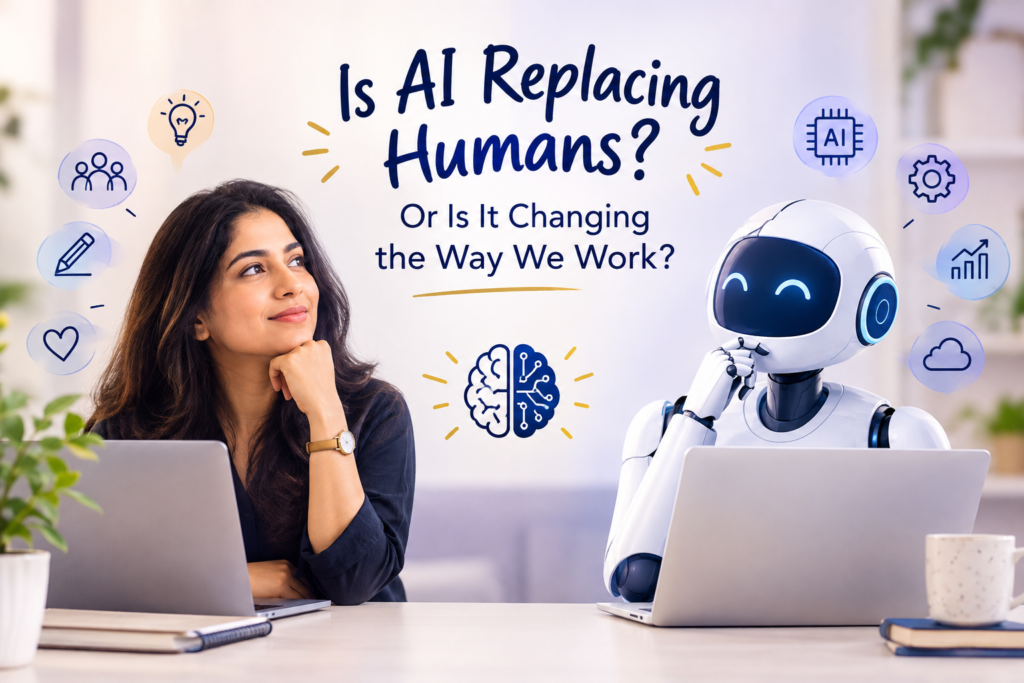
The Question Everyone Is Asking
“Will AI take my job?”
It is one of the biggest questions of our time.
From writing and designing to marketing, coding, customer service, and education, artificial intelligence is changing the way people work. AI can generate content in seconds, analyse huge amounts of information, create images, answer questions, and automate repetitive tasks.
So, should we be worried?
Is AI really going to replace humans?
The answer is more complicated than a simple yes or no.
AI Is Powerful — But Humans Are Different
Artificial intelligence can process information incredibly quickly. It can identify patterns, generate ideas, and perform repetitive tasks efficiently.
But humans bring something different to the table:
Emotion. Experience. Empathy. Intuition. Creativity.
A machine can generate a story, but it does not experience the emotions behind that story.
AI can suggest a marketing campaign, but understanding why a particular audience feels connected to a brand requires human insight.
AI can create an image, but the reason behind creating that image comes from human intention.
This difference is important.
AI May Replace Tasks — Not Necessarily People
One of the biggest misunderstandings about AI is that it will simply replace entire professions.
In reality, AI is often changing how jobs are performed.
A marketer may use AI to analyse data.
A writer may use AI to brainstorm ideas.
A designer may use AI to explore concepts.
A teacher may use AI to prepare learning materials.
A business owner may use AI to automate routine tasks.
Instead of doing everything manually, professionals can use technology to work faster and focus more time on higher-value activities.
The future may therefore be less about humans versus AI and more about humans working with AI.
What Happens to Creativity?
This is where the conversation becomes interesting.
AI can produce thousands of ideas.
But creativity is not simply the ability to generate ideas.
True creativity involves understanding people, culture, emotions, experiences, problems, and context.
A human can look at a situation and ask:
“What does this person actually need?”
That question can lead to an idea that technology alone may not understand in the same way.
AI can assist creativity, but human perspective gives creativity meaning.
The Skills That Will Matter in the Future
As AI becomes more capable, some traditional skills may become less valuable on their own.
Simply knowing how to perform a repetitive task may not be enough.
Future professionals will need skills such as:
- Critical thinking
- Creativity
- Communication
- Emotional intelligence
- Problem-solving
- Adaptability
- Digital literacy
- Strategic thinking
- Collaboration
- AI literacy
The ability to learn, unlearn, and relearn may become one of the most important skills of all.
Students: Don’t Be Afraid of AI — Learn It
For students preparing for their careers, AI should not be viewed only as a threat.
It can also be an opportunity.
Instead of asking:
“Will AI take my future job?”
ask:
“How can I use AI to become better at my future job?”
Learning digital tools, understanding AI, developing communication skills, and building real-world experience can help students prepare for a changing workplace.
The goal should not be to compete with machines at everything machines do well.
The goal should be to develop the skills that make humans valuable alongside technology.
The Human Advantage
Imagine two professionals.
One knows how to use AI but has no ability to think critically.
The other knows how to use AI and understands people, communicates clearly, solves problems, and makes strategic decisions.
Who is more valuable?
Technology can provide information.
Humans provide direction.
Technology can generate possibilities.
Humans decide which possibility matters.
Technology can automate tasks.
Humans decide what should be done.
That human judgment remains extremely important.
The Future Is Not Human vs AI
The real transformation is already happening.
AI is becoming another tool in the professional toolbox—just like computers, smartphones, search engines, and other technologies transformed work in previous generations.
People who refuse to adapt may struggle.
People who learn how to use new technology intelligently may have an advantage.
But the most successful professionals may be those who combine technology with uniquely human skills.
So, Is AI Replacing Humans?
Not exactly.
AI is replacing some tasks.
It is changing many jobs.
It is creating new opportunities.
And it is forcing professionals to rethink what valuable work looks like.
The bigger question is not:
“Will AI replace humans?”
It is:
“Will humans learn how to work with AI?”
The future belongs neither entirely to humans nor entirely to machines.
It belongs to people who can combine human creativity, intelligence, empathy, and judgment with the power of technology.
AI may be changing the workplace—but humans still decide what the work means.